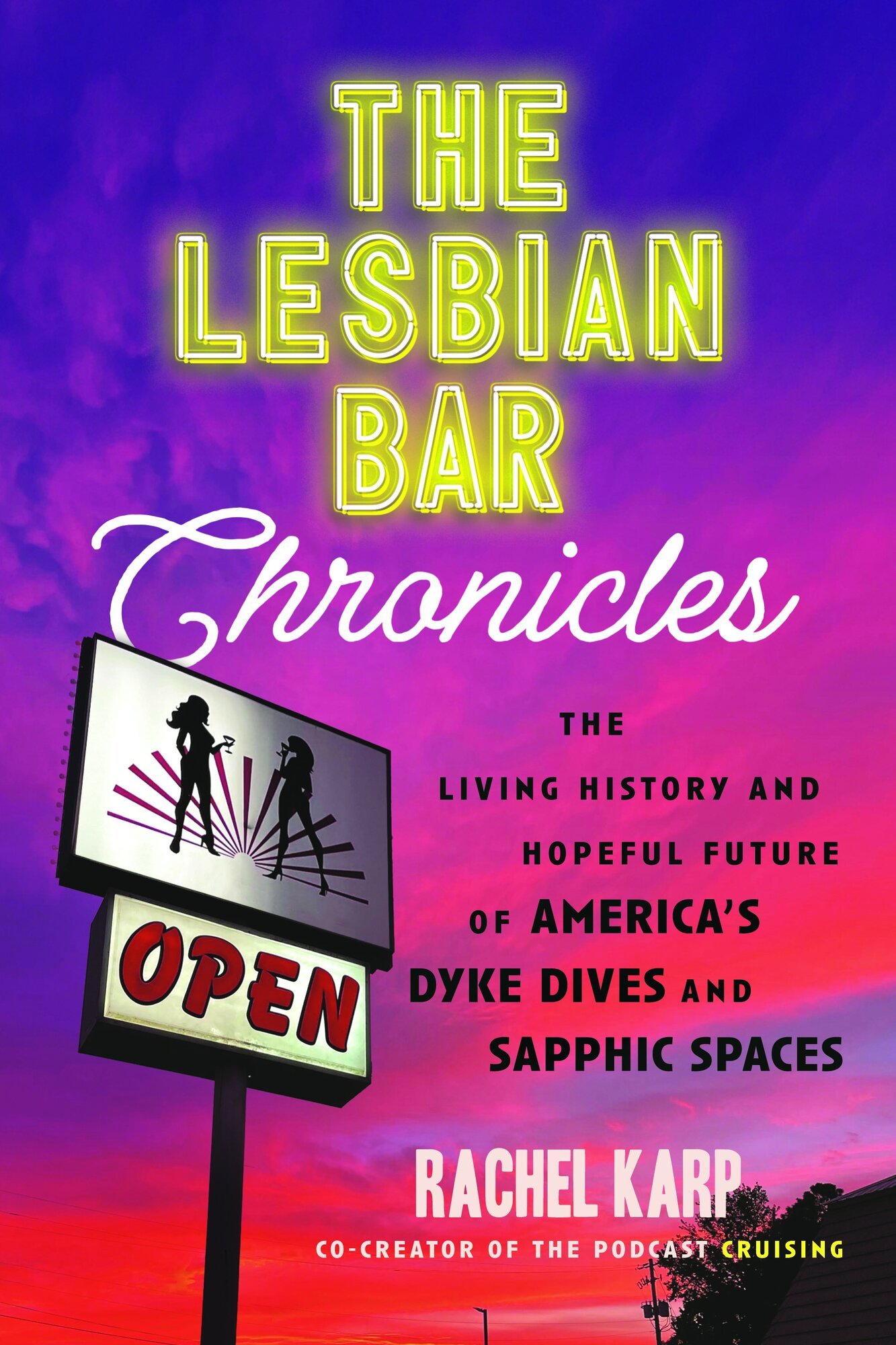
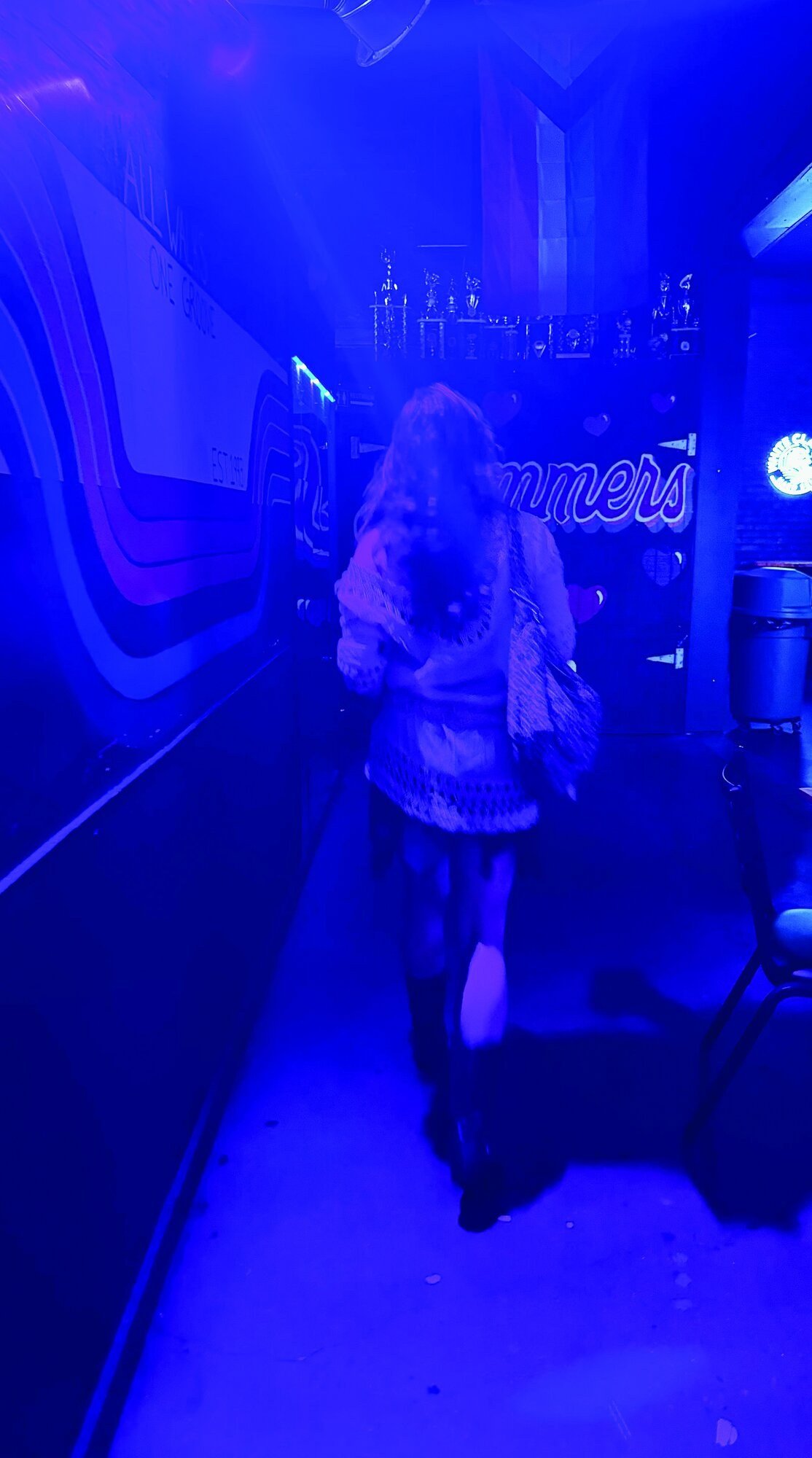
As someone who was completely broke and mostly sober throughout my twenties, I never went to bars much. So when I got asked to review The Lesbian Bar Chronicles: The Living History and Hopeful Future of America’s Dyke Dives and Sapphic Spaces, I thought I should check out some of Pittsburgh’s spaces. First, I stop by The Soft Spot, a Sapphic-centered sober space. It’s game night, and a group of multiracial queer people are playing Hedbanz, which is about the most wholesome thing I have ever seen. Then I walk down the street to Mary’s Bar, a local glam dive and community space. It is 7 p.m., off-hours, but the bar is half full—a table of lesbians, gays, and queens at the bar and an old tattooed bear and his femme girlfriend being served by the hot gender-ambiguous bartender. The DJ is playing Siouxsie and the Banshees. I am writing this review while sitting at a little heart-shaped table next to a photo booth, electric candlelight illuminating my notebook. This feels like a bar where I belong.
Bars play an outsized role in LGBTQ history—Exhibit A: the Stonewall Inn—but when I was researching Red Dora’s Bearded Lady Coffeehouse for my forthcoming oral history about the 1990s San Francisco dyke scene, most of the interviewees were cold to these old gathering spots. Miriam Klein Stahl recalls sneaking into a lesbian bar as a teen where “they were playing music like Huey Lewis and the News or, at best, Brandi Carlisle” and “people were dancing in a way that my body just did not want to move.” “We just didn’t feel like the bars were our bars,” Harry Dodge, one of the founders and curators of the Bearded Lady told me. “And they weren’t—they were bars from a different generation. We wanted something new. Those spaces were important; they just weren’t ours.” If Dodge and Stahl have what might be termed aesthetic and generational critiques of lesbian bar culture, author Caro de Robertis establishes political and even moral issues also at play. Their book So Many Stars: An Oral History of Trans, Nonbinary, Genderqueer, and Two-Spirit People of Color (Algonquin Books, 2025) describes the de facto segregation in the San Francisco lesbian bar Amelia’s: “White people stayed downstairs; Black people went upstairs,” C. Njoube Dugas tells de Robertis. “You could be downstairs if you’re Black but only during certain hours [. . .] it wasn’t like there was a rule, that’s just how it was.”
The importance of bars and lesbian or dyke-specific spaces as a place to find others—and therefore find yourself—is omnipresent in these oral histories.
And yet the importance of bars and lesbian or dyke-specific spaces as a place to find others—and therefore find yourself—is omnipresent in these oral histories. The amazing feeling when you find your place! Tupili Lea Arellano told de Robertis about going to an inclusive gay bar in Tucson run by “diesel dykes” that was full of drag queens, lesbians, and gay men. “It was a feeling like the world had opened up to me, like there was a place for me in the world. There were people who looked queerer than me!” And in my Bearded Lady interviews, Kristen Dilly recalls going to gay clubs and thinking, “These are really weird. I don’t think I’m gay.” Then she found the dyke scene connected to the Bearded Lady and realized, “Oh, hell yes! I’m gay! Here we go!”
Rachel Karp approached The Lesbian Bar Chronicles as a quest, just like another book I’ve loved recently, Amin Ghaziani’s Long Live Queer Nightlife: How the Closing of Gay Bars Sparked a Revolution (Princeton University Press, 2024). Both books want to know why so many gay bars have closed in the past decades, a trend that preceded the coronavirus pandemic. Ghaziani quotes a 2019 story in Bloomberg that counted 2,500 gay bars in the United States in 1976 but fewer than 1,400 worldwide fifty years after Stonewall. But nostalgia for a lost time is not the answer. Ghaziani says the trouble with having a “narrative that ‘life was once better with gay bars as far as the eye can see!—but the situation now is bleak,’ is that it erases what else is happening—night life is evolving, not dying.” Whereas in Ghaziani’s London-based research, the traditional gay bars mostly catered to white gay males, and the focus of his research—club nights—are mostly queer-, trans-, and BIPOC-run and flourishing!
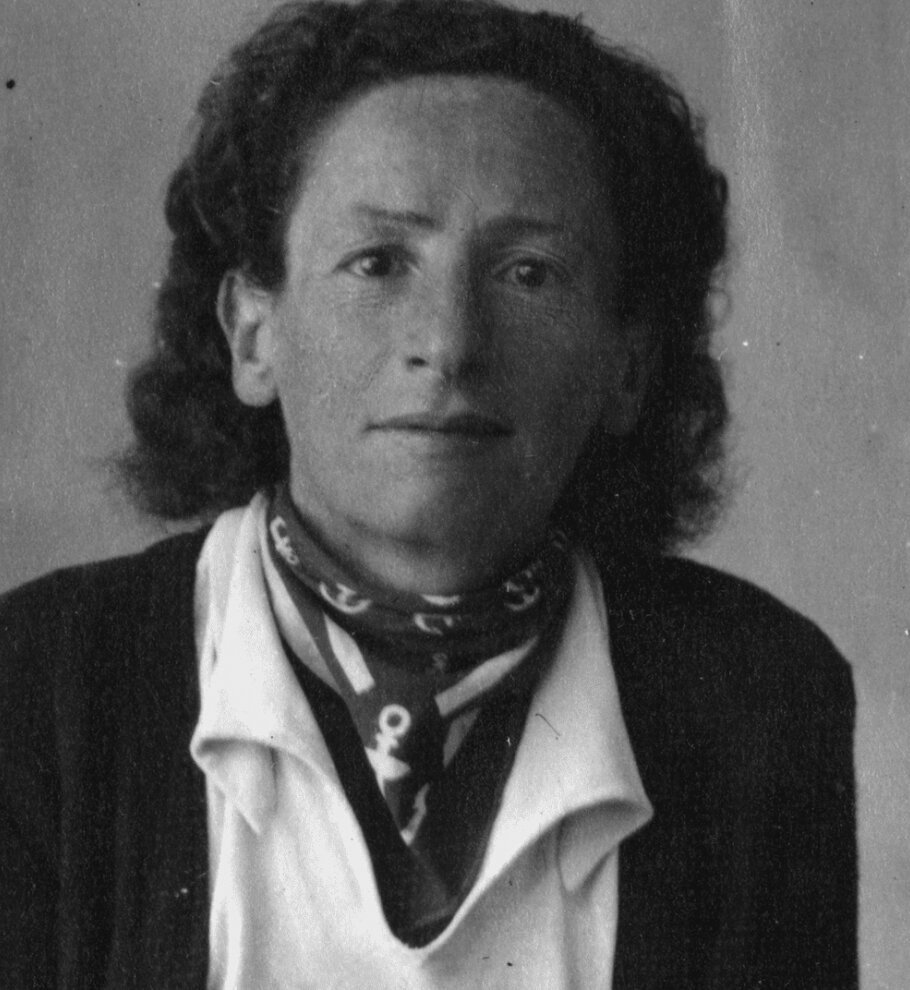
Likewise, The Lesbian Bar Chronicles and its preceding podcast Cruising, which she makes with Sarah Gabrielli and Jen McGinity, pivot from the question of why bars are closing and instead asks: “How do these spaces survive? How are they built? How do they support us? How do we support them? How are they intertwined with our community, our history, our fight for liberation and our chosen families?” Figuring this out is a delightful ride. We take off from New York’s Greenwich Village, where we spend time learning about Eve’s Hangout, a lesbian tearoom and salon that existed during the 1920s, run by a butch Polish immigrant named Eva Kotchever (née Chawa Złoczowe and pen-named Evelyn Adams). Eva wrote for the anarchist journal Mother Jones (founded by Emma Goldman), hosted writers like Anaïs Nin, and self-published a book of short stories called Lesbian Love. That last item helped bring about her downfall, when, in 1926, she was befriended by a woman who purloined the book and turned Eva over to the police. After her arrest for obscenity, she was deported to Poland just in time for the rise of the Nazis and was sent to Auschwitz to die in 1943.
The queer bonafides of the flapper-era Bohemian downtown then gives way to New York City of the 1980s and 1990s, another dramatic era filled with threats and death but also AIDS activism, Lesbian Avengers, dance parties where flyers had to be printed out and mailed to people’s homes, Olivia cruises, softball, the reclamation of the word dyke, and the evolution of lesbian bars to their modern form: inclusive. While Eve’s Hangout reportedly had a sign that read men are admitted but not welcome, today’s bars have added subtitles like the bush: a dyke bar for queers and henrietta hudson: a queer human bar built by lesbians. Bars survive, this book seems to be saying, by evolving.
The Lesbian Bar Chronicles continues in this vein, weaving together thrilling lesbian history with descriptions of current bars and lesbian spaces. In Chicago, at the bar Nobody’s Darling, we meet Shirley J, who, in the late 1970s, ran a party night that took over a warehouse and became a club—The Warehouse—with Frankie Knuckles as DJ, which was where house music was born. In San Diego, we wander into Gossip Grill and meet regular Lisa Ramrod, a member of Sisters of Perpetual Indulgence, an “order” of queer and trans performance artists and activists. Ramrod has a personal mission of helping people who, like her, have invisible disabilities. Karp describes what sounds like the grooviest afterlife ever: “The bar houses a disco ball shrine for people who have passed, and whenever someone loses a loved one [. . .] their picture gets placed inside the ball.” This way, “they’re always dancing, they’re always a part of our lives,” she quotes Moe Girton, the owner of Gossip Grill.
Meanwhile, strategies to prevent sexual assault are not just talked about at A League of Her Own (Washington, D.C.). The bar has an “enthusiastic model of consent” for buying drinks: “You can only order as many drinks as there are people in front of the bartender. And everyone must confirm that they want one.” In Portland, a group of friends’ ongoing joke about starting a sports bar called The Sports Bra, which only plays all-women’s sports on the TVs, becomes a reality. Notably, the bar is open to minors before 10 p.m. because “so many young girls drop out of sports thinking that there’s no future for them,” says bar owner Jenny Nguyen, so The Sports Bra is there to combat that. The owner of the Lipstick Lounge in Nashville was kicked out of her own church for being gay, and so each Sunday, she turns her hot-pink bar into a place of worship.
When they began their quest, Karp, along with her podcast cohort of Gabrielli and McGinity, set out to capture as many stories as they could—and what a success both the podcast and this book are! The Lesbian Bar Chronicles is a fun exploration of how and why physical spaces remain fundamental to our survival and our LGBTQIA+ cultures.
Just reading this road trip/love story, especially nestled at a heart-shaped table while listening to “Peek-a-boo,” gives one that longed-for sense of belonging. It is an introduction to queer history for younger readers and a salient reflection for those of us who lived through some of these historic times. Reading The Lesbian Bar Chronicles leaves you feeling so joyous, it kind of makes you want to open a bar.