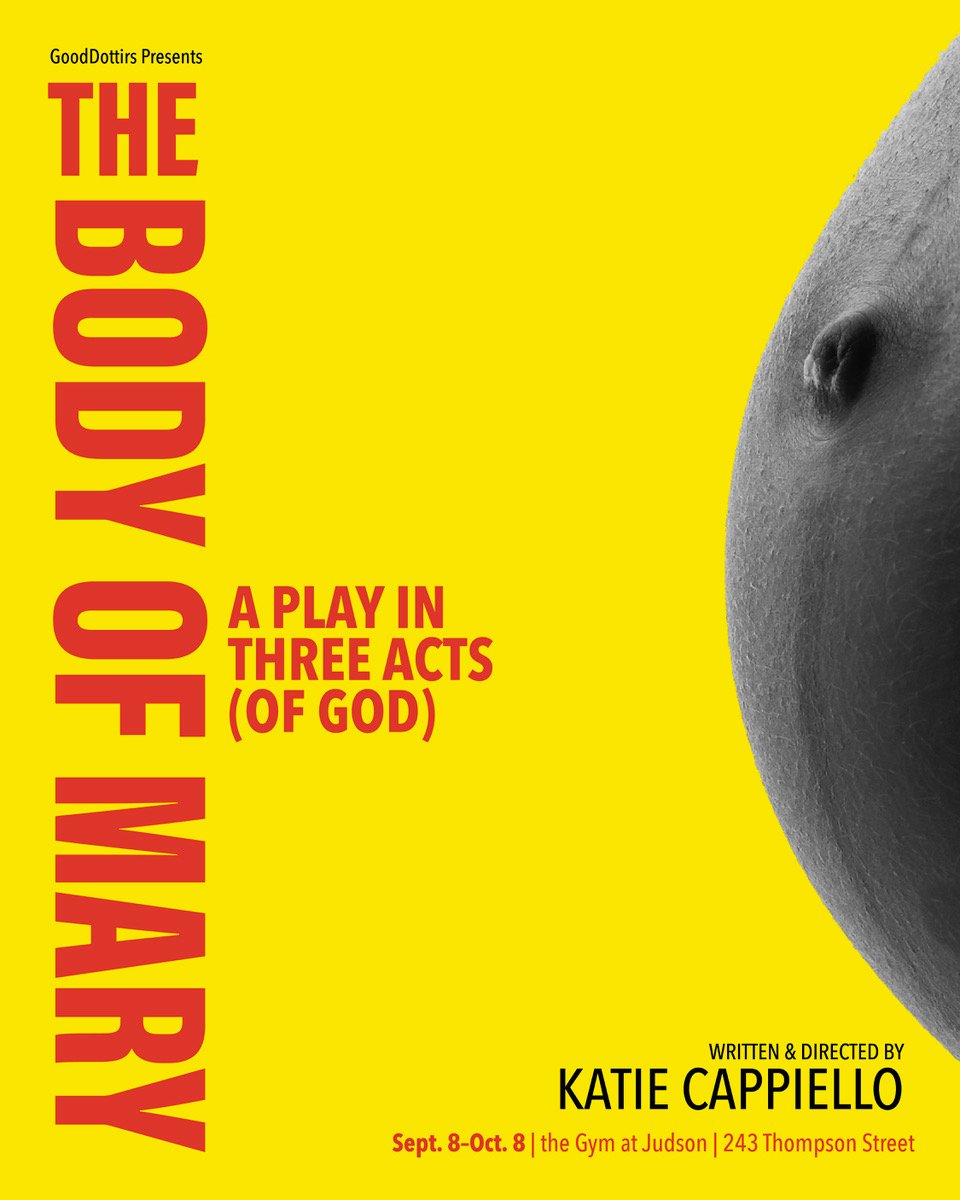
I spent the summer working for my professor, Jennifer Baumgardner, in New York City. The work was … eclectic. For instance, one day I wandered the sticky-hot streets of the East Village with a roll of posters featuring bloody underwear under my arm and a bowl of clumpy homemade glue in my hand. Pre-production for The Body of Mary was in full swing and I was both part-time PA and a fly on the wall. So enmeshed was I in this show that when I left for junior year at Smith, I could have performed a one-woman version on demand. I was not prepared, therefore, for what I encountered when I finally saw the full production in the Gym at Judson Church. My mom, whom I had purposely kept in the dark about the show’s plot—was downright shell-shocked. “Life changing,” she said as we rose shakily from our seats. “I’ll need a minute to process it all.”
While she’s processing, let me back up. Katie Cappiello is a playwright, director, and theater teacher with an ear for how people, especially young people, really speak—and a keen feminist radar. Her work frames the everyday horrors of being a girl or woman in a sexist world without devolving into banal messages, tidiness, or moralizing.
Act I is about the Virgin Mary, as in Jesus’s mom. We all know this Mary. We’ve seen her gaze at churchgoers, eyes downcast, from stained glass windows or huddle peacefully with Joseph in life-size Nativity scenes. But here, portrayed by Annalisa D’Aguilar, she looks different. She’s joyful and dreamy-eyed even as she scrubs laundry—until she hurls into a bucket. She wears the classic cobalt blue dress associated with the Virgin, but her feet are shod in white high-top Converse, much like my own. By modernizing “ancient” times, Cappiello reminds us that Mary was a real person—a girl. She’s thirteen-years-old, we’re told. She even wears a red ribbon in her curly hair.
Mary is pregnant, though no one has let her in on this fact. Enter Gabriel (Ben Cook), who claims to be an angel with a special proposal for Mary: God wants her to be the mother of His child! Mary is confused. Gabriel and Mary’s parents come up with more and more outlandish reasons why a virgin pregnant via God-magic makes perfect sense. The laughs keep coming—fast, furious, and clever, like a good sitcom—until it suddenly isn’t funny at all. “How can I already be with child,” Mary asks her father. “You said I was a virgin … No matter what that Roman did to me.”
By the time a railroaded Mary of Nazareth is physically trapped between her grinning parents, trying not to cry as she thanks a smug Gabriel for “this opportunity,” I found myself welling up. In this annunciation, Mary is not a serene servant of God. She is terrified. This story was one of betrayal, not holiness. I couldn’t help but think, how was a religion built on top of this?
Act II introduces us to New York’s Cardinal O’Malley (David Hull), a frat bro with a frightening amount of religious authority. He pitches 59-year-old Mother Mary Joseph (Tracy Sallows), the selfless head of a busy Order another annunciation of sorts: to be implanted with abandoned embryos. Abetted by his sadistic Irish sycophant (Mary Jo Mecca, who also plays Mary’s mother in Act I) and a spineless Father Donato (Ben Cook again), O’Malley won’t stop until Mother Mary is vanquished.
Cappiello has referred to Act II as “absurdist,” but it felt realistic to me. Not just because of the Chick-fil-A wrappers littering the Bro-Cardinal’s desk, but because of ubiquity of this kind of character—the smiling “nice” guy who pushes past a woman’s no. As this act draws to a close, a soon-to-be-implanted Mother Mary invokes Mary of Nazareth, and the theater is filled with the haunting sound of “Ave Maria.” To my delighted surprise, the song was performed live by the young opera singer Lu Yi Peng. As she walked onstage and remained for the scene change between Acts II and III, my mind flooded with memories of the few church services I went to as a kid and the peacefulness of the hymns. This clear depiction of the horrors of the Church is tangled up in beauty, just like most people’s relationship with religion.
We’ve reached our final Mary. She’s from Nazareth, Texas—that state being ground zero for “pro-life” laws that are in truth anti-woman and anti-child. This Mary (Gracie Conn), just off her late-night shift at Dairy Queen, commands the stage alone for the whole scene, accompanied only by her best friend Nevaeh (Annalisa D’Aguilar, Mary of Nazareth in Act I) on a never-ending phone call. Mary finds a baby in the dumpster outside of the DQ, and although physically alone, this is the first Mary to have anyone on her side. The two actors have a wonderful, goofy back-and-forth that is so genuine, I feel like I’m on a call with my friends. Together they scheme ways to save the baby without harming the mother, displaying the empathy I’m desperate for after Acts I and II. It’s no coincidence this solidarity comes from two teenage girls.
“The mom could, like, be our friend,” Mary says.
“This is what I’m saying,” Nevaeh responds.
“She could be us,” says Mary.
They decide against calling the cops, despite having no idea how to even feed this newborn, in case the baby’s DNA could be used to arrest the mother. The girls intuit that the powers that be are not to be trusted. They have to rely on themselves and their compassion for the baby’s mom.
Because the scenes are so funny, the audience is caught off guard by their horrifying implications. This emotional whiplash is a Cappiello specialty. Humor invites the audience to let their guard down, and open themselves to the hard truths, like how Mary was “chosen” not by God, but by ordinary men. Or how Mother Mary Joseph had given her “whole life to the Church,” so what choice did she have other than to comply with their latest demand?
“This is low-key Handmaid’s Tale!” Mary of Texas shrieks after she successfully gets the baby out of the dumpster. Yes, so much of life is low-key Handmaid’s Tale, like my mom’s former boss who literally advised her to “marry an old, rich man” when she asked for a raise. Forcibly impregnating nuns might be a degree of horror we haven’t seen yet, but no one would be surprised if that was a New York Times headline tomorrow.
Once my mother took her “minute to process,” she had plenty to say. About Cardinal O’Malley: “I hated watching him. I’ve met that man too many times in real life.” Mostly she was amazed thinking about the Christian teachings of her childhood and how unquestioningly she had absorbed the lore despite having counter-knowledge derived from her own experience giving birth (twice).
“Of course Mary got pregnant the normal way,” my mom said, meaning via rape or sex. “How did I never realize that before?”