Year two of the pandemic, the nurse at the office of the specialist I see to help manage chronic illness began evincing incredible behaviors. Although she worked with immunocompromised patients, she refused to get vaccinated until threatened with job loss. She discouraged patients from getting vaccinated themselves, alluding to rumored surveillance devices hidden in the vaccines. She offered treatment regimens—out of earshot of the doctor, of course—that she found on social media. Ingesting a small amount of bleach every day, she suggested, would not only kill off the COVID-19 virus but also eliminate the disorders for which I was seeing the specialist in the first place.
Although these utterances are all from the MAHA Conspiracy Playbook, she did not limit herself to the script. She expressed the belief that I did not have the autoimmune diseases for which I saw the specialist—whether because I was lying about them, or because they did not exist, is unclear. She scoffed when my specialist tested my joints, admonishing that I could “do better than that”; she skipped the pain-scale questions standard to initiate office visits for people with chronic pain disorders.
I started getting headaches from all the eye-rolling I did at my doctor’s office. Still, the situation was survivable until the day the nurse determined that I no longer needed my primary medication and refused to submit the required paperwork to my pharmacy. My doctor promised to talk to her, although if this happened, she remained uncompelled. My GP fared no better. A patient advocate assigned to the case merely justified the nurse’s conduct (“We are all under a great deal of strain right now, and the hospital is so understaffed”) but did nothing to correct it. I was unmedicated and in such extreme pain, I could no longer leave my bed. If you don’t know what this is like, I promise you it is bad.
I called the state medical board. They sent me to a website with forms, which I completed, supplying details on my interactions with the nurse and copies of letters she had written outlining her refusal to procure my medications. It was a thick packet, forming a highly detailed complaint against a woman who was putting my life in danger. I dropped it in the mail.
I never heard anything back. The state medical board’s website is clear about the procedure: every complaint they receive is investigated, and every party found responsible is held accountable. The state medical board’s position appears to be that sick people who become aggrieved by care practitioners should not have to manage their own complaints process.
So, there was no single moment that my complaint felt resolved, although subtle changes emerged from the office right away. I received my medication within days. This particular nurse was out of office for a while, and when she came back she did not interact with me. The prescription-filing process was streamlined and digitized. Months later, my specialist apologized for the ordeal, detailing several matters that I had never mentioned to her. Someone else had clarified to her the nurse’s most distressing behaviors.
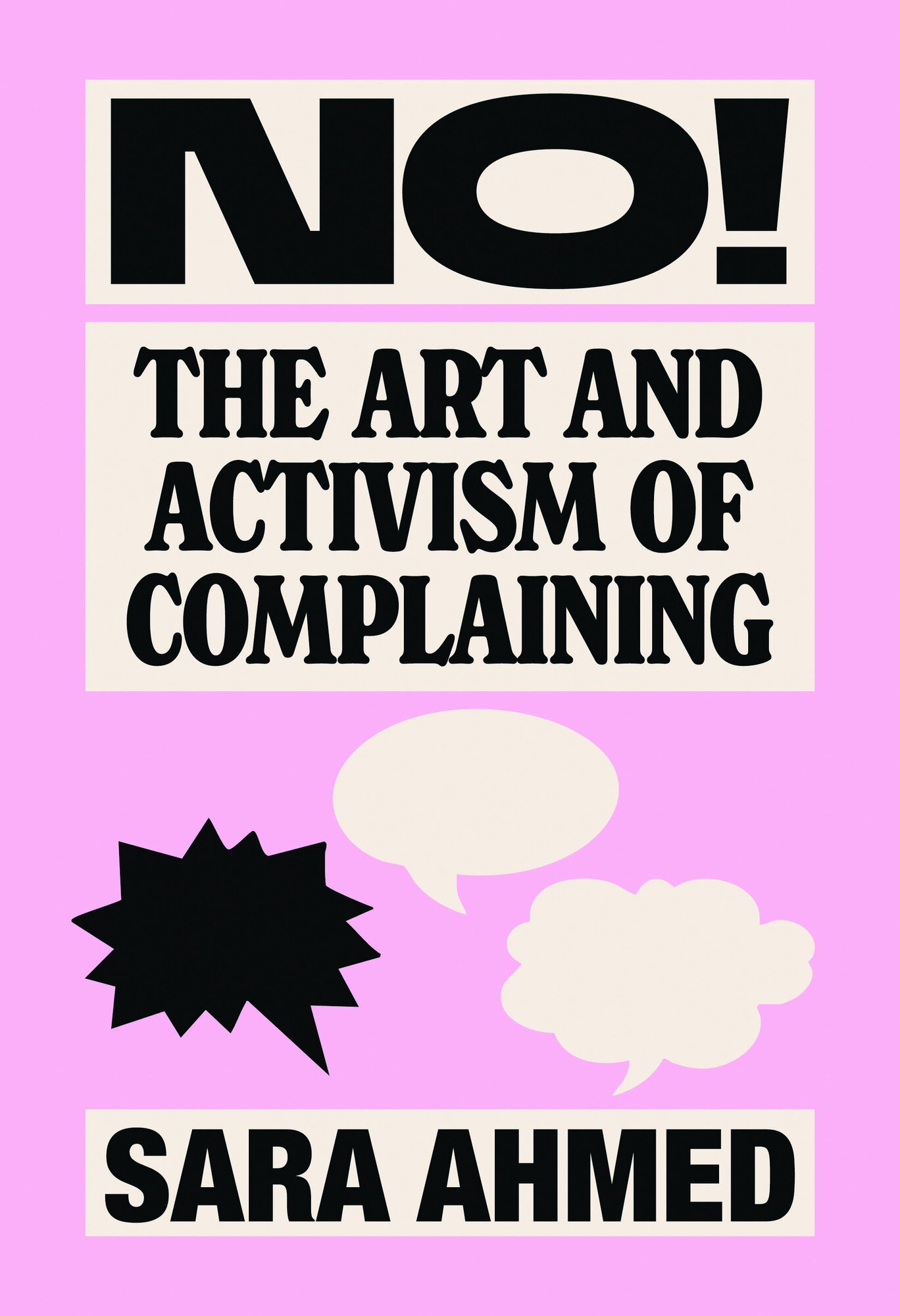
I share this story because it offers the kind of satisfying narrative that goes untold in Sara Ahmed’s NO! The Art and Activism of Complaining. Not to suggest that the book itself is unsatisfying, but it does have a particular scope. The latest project from the author of The Feminist Killjoy Handbook catalogues the life of a complaint within an educational or research institution: its inception in the moment of sufferance, its nurturance into fully articulated disavowal, the decision it must make once mature to lodge itself formally, or to remain fully articulated in the heart of the complainer. If the complaint is formalized, uncovering in-place procedures to file it—should any exist—can be a slog. Then it may be mishandled, watered down, ignored, or dealt with informally, which is to say not at all. It is Ahmed’s contention that complaints at any stage of evolution are significant to our political lives, whether they are ever aired or resolved. “[B]y complaining you are expressing the values and commitments as you work them out: what you bring to the world. You are modelling the world you wish for,” she writes. Complaints—their subjects, processes, and ultimate (if extremely rare) resolutions—fill out the bulk of the book, told through case studies Ahmed collected after filing her own sexual harassment complaint at Goldsmiths, University of London. Her unresolved complaint, submitted alongside those of several students, led to Ahmed’s resignation from the university.

This is not a book about grievances, gripes, laments, quibbles, objections, protests, or concerns, and it is not really about refusals or outright rejections (although NO! is a far superior title to Let’s Go Visit HR!). In other words, Ahmed is not cataloguing the emotional aspects of what is understood to be a largely intellectual process (although that would be worth doing, for the grief of a grievance remains largely imagined in NO!), nor is she documenting the physical impact of complaints (also worthy). Instead, the book attempts to gird potential complainers through the process despite the many pitfalls. “When complaints end up in filing cabinets, the point seems to be less about retrieval and more about putting them where they are harder to find,” she notes. Two brief sections at the back—a survival guide and a curriculum—offer complainers explicit support as they move through the process. It is not an uplifting read.
Most complaints in the book address sex discrimination, sexual assault, harassment, bullying, and racial and gender bias in educational and research institutions. While Ahmed alludes vaguely to other institutions, they receive little attention and almost no fleshing-out in case studies.
Relatively few case studies concern barriers to access for people with disabilities, an oversight with consequences. One of these consequences is the sameness of the complaints process for able-bodied folks: most case studies presented seem not to satisfy their narrators or lead to anything but frustration, sorrow, resentment, and rage. Late in the book, victories start to appear, some won by people with disabilities. Strangely, these offer the book its only bright spots. One could allege that Ahmed failed to offer voice to folks battling institutional ableism until she needed our inspirational stories—although I suspect that her project, having emerged from stories she heard while publicly detailing her own frustrating complaints process, merely reflects her milieu. I’m not here to keep score: Ahmed’s on my team (full disclosure: we share a publisher). But the complaints alleging ableism that appear in the book were won at least in part because complainers turned to external organizations or institutions for support. “Tony Jones,” Ahmed writes on page 200, “lodged a complaint with the Royal Commission in Australia,” after the airline Jetstar refused to offer him seating accommodations. He wasn’t content with the customer complaint process the company presumably offered him; he went straight to a government oversight committee, just as I did when my patient advocate sought to mollify me instead of correcting my nurse’s destructive behavior.
If you have not previously complained about an institution, [Ahmed’s] words act as a guiding text; if you have, they are a solace.
I turned to the state medical board because it is an external entity tasked by law to ensure accountability and compassion in matters of care. Institutions, including educational and research facilities and hospitals, prefer to self-govern. They believe themselves to be authorities on how knowledge is to be assessed and accessed; that they would resist hearing and responding to complaints follows logically. Ahmed’s survival guide offers readers fortification to engage in the complaint process anyway: practice, work with like-minded others, document everything. If you have not previously complained about an institution, her words act as a guiding text; if you have, they are a solace. (“It helps to do this work as a part of a team, to be a complainer who has found other complainers,” Ahmed writes in her Complainer’s Survival Kit under a section labeled “Create a Complaint Collective.”)
Yet the particular scope of the project does not allow for much acknowledgment of external entities in place precisely to shift the unwieldy power dynamics the book otherwise describes. Unions and equality networks are mentioned in the survival guide, but we’re often left to accept institutional logic by viewing the internal complaints process as necessary to institutional change. (Ahmed expresses concern for swallowing the logic of the institution but does not explore it.) Toward the end of the book, I began to imagine something like a state board of public health—a distinct, perhaps publicly funded, committee—to defend those facing bias, harassment, and discrimination; who might review every documented complaint, investigate thoroughly, maintain anonymity, and administer repercussions directly to those found accountable. After all, if our only path to justice is through dreaming, why not dream big?
Dreaming is not on Ahmed’s agenda. Gritted but not unhopeful, NO! offers an excessively realistic approach to battling institutions on their own terms. We are urged throughout to be aware of the many situations others have complained about, often to no avail, and we are emboldened to complain about them still.
Which raises one final gripe, although we can hardly blame the author for it. Ahmed’s research is focused on the UK, a familiar-looking world that quickly dissolves into uncanniness. As Ahmed was, I used to be surrounded by people lodging, or considering lodging, complaints about discrimination, harassment, and bias at teaching posts, or who were working out creative, alternative means of filing such complaints in the public forum. Here in the US, I am now surrounded by exhausted people whose teaching jobs are in jeopardy, or who have already lost them. (I appear to have lost mine in recent weeks.) Racism, sex discrimination, ableism, and gender bias all play significant roles in who is impacted by these job losses, of course, as does the former employee’s voicing of previous complaints. Yet the time to lodge a new internal complaint seems to have passed here for those of us now outside these institutions, while those who fear job losses may be unwilling to voice further concerns. The ripple effect of this is disheartening, as I suspect that our former students will no longer be supported in viewing their annoyances as emerging from systemic problems and have fewer resources to perceive themselves as eligible to engage in a formal complaints process. I struggle to see NO! getting passed around US campuses as the vital handbook it should be.
Yet the book stands as one of few offering support to institutionally engaged dissenters. Perhaps we in the US sense it’s too late to complain precisely because we have gone without NO! for too long.