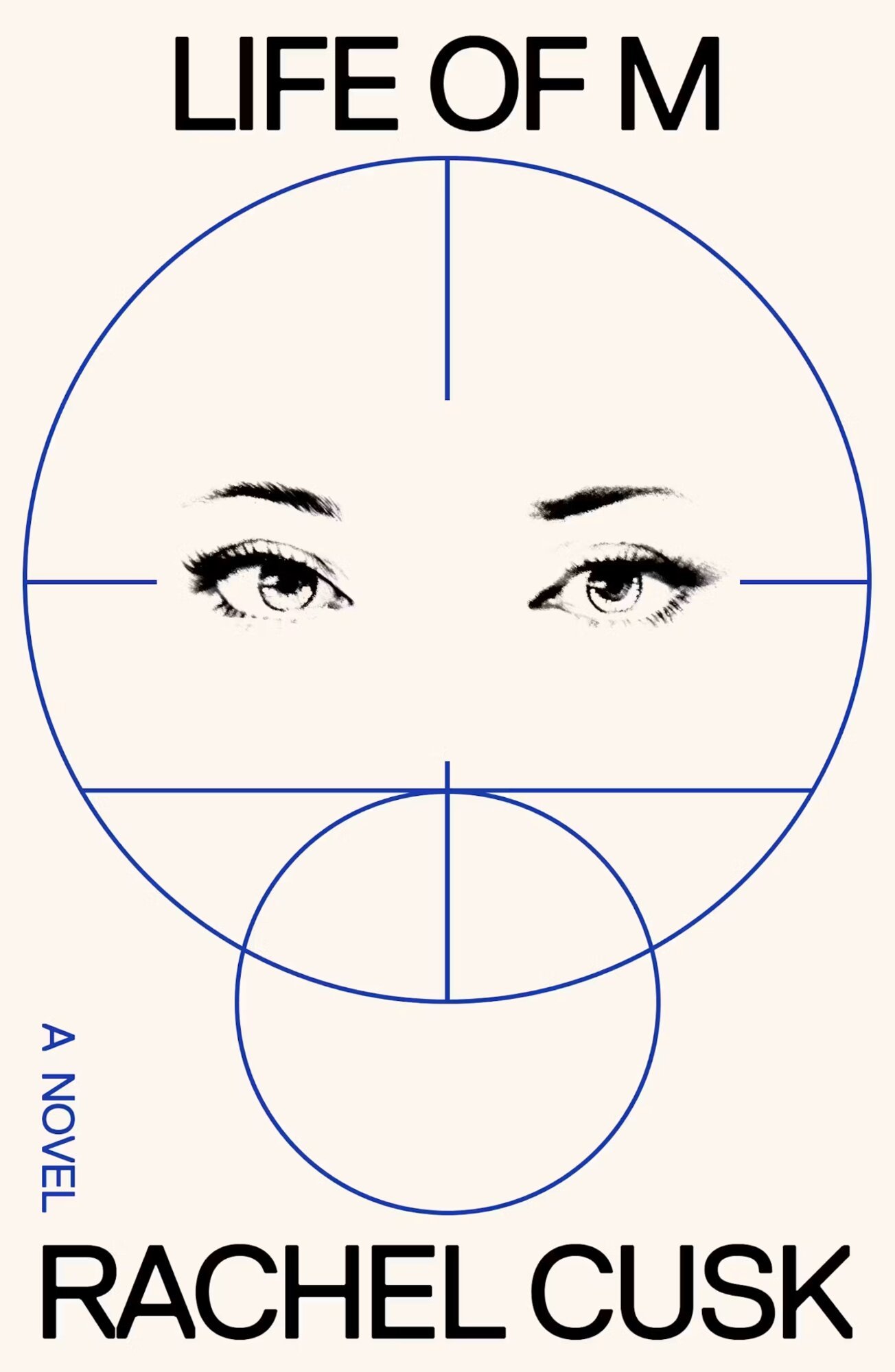
I had anticipated that Rachel Cusk’s latest would be a captivating work of big ideas. The premise—a nameless narrator encounters one of the great and celebrated film actors of the era and then attempts to write an “autobiography” of said star—is both juicy and think-y, a stage upon which brilliant observations can mingle with feminine angst and glamour.
I was enthralled by a similar quality in Cusk’s novels of the last decade, which were distinguished by their formal innovations while maintaining some straightforward elements of fiction. In the Outline trilogy, her first-person narrator is a kind of vessel, scraped of interiority and individual motivation as she listens impassively to the life stories of those she encounters. It has the allure of gossip, the thrill of listening in as others confess where they have been and how they think. The novel Second Place, in which a great man painter stays in the guest cottage of the narrator, a middle-aged mother, throbs with the palpable urgency of frustrated artistic ambition. Cusk’s essays, too, brim with real and ugly feeling. A Life’s Work, Cusk’s nonfiction book on motherhood, was handed to me by a publishing colleague with the explanation that she gave it to all her friends when they were about to have their first child. These were women who thought about their appearance a bit but were most accustomed to the life of the mind; Cusk’s essays were a useful reference during a moment of being forced into body. That ritual exchange reminded me of passing around Joan Didion’s work in my twenties, when all the women I knew identified as intellectual and ambitious and also interested in the inner lives, messy romances, and wardrobes of famous actresses.
Life of M offers some of those same pleasures: an interest in the floating world, but with intellectual gravitas. The conceit seems an inversion of the Outline formula—rather than a narrator losing themself in the monologues of others, here a first-person narrator disappears into the third-person imagining of one fascinating, glamorous figure. As the narrator begins to limn the experience of M, we get a bit of refracted glamour. We see her beauty and goodness, her reproduced image, the elevated milieus in which she moves. M as in Marilyn, Meryl, Margot? The actress is contemporary, but she has that cipherish quality with the murmur of mammary, of mama. Her image is used by “a major brand,” and she does literary events for a fashion house’s high-concept promotional strategy—a model, a journalist, an author, an actress (M), in a staged discussion. (I pictured Emily Ratajkowski, Sloane Crosley, Cusk herself, and Natalie Portman, and it has since been reported that Portman was Cusk’s inspiration.) M is a natural subject of fascination. But in the end, M resists the narrator’s attention, and there is, in fact, something quite resistible in Life of M, as if it were conceived as an experimental challenge to readerly engagement.
The novel’s aesthetic choices rebuff whatever stranger might seek to give it attention. For instance, Cusk will devote pages to the description of interior spaces (“Each bedroom has a large bed of the greatest comfort, as well as extensive storage behind closed taupe-painted doors”) without any of the conventional novelistic signals of significance: a human point of view experiencing, responding to, projecting on the space described. The first sentence after many section or chapter breaks often begins with a referentless It (“It is a bookstore and it is closed”; “It is a terrace above an olive grove, with a vague view of the sea”). The grammatical refusal of specificity, especially in those transitions where we expect an author to ground us, creates a destabilizing effect. One wants to ask: What is a terrace? Is the terrace both a terrace and something else? Who is observing this terrace, and why does it matter to them? The chapters on M alternate with chapters told by an unspecified we that seems to be coded female (“Our bodies are not young and they are not old, they are in some sense ageless or perhaps simply obsolete […] they have performed their reproductive function”), though not as clearly as the collective feminine voice of, say, Annie Ernaux’s The Years or Julie Otsuka’s The Buddha in the Attic. Although I initially took these chapters to be told by a collective voice, the novel’s final scene—a possible misgendering of the narrator—left me wondering if all along the we was the narrator and the narrator’s partner, i.e., a married couple.
The partner comes up early in the novel, having had a frightening medical event just after the narrator’s chance encounter with M in a bookstore leads to M’s approval of the autobiography concept. Later, when M comes to view the narrator’s project not as an interesting lark but as something more ominous and inimical to her, the narrator explains that it was the partner’s near-death experience that propelled the project, for the event left them “frightened of living.” The narrator tells M that “living inside someone else […] helped me.” When the narrator’s own life becomes unbearable, imagining the inner life of a famous woman is a relief. “Using an actor […] enabled me to relinquish my own experience.”
Though the partner’s near death jump-starts the plot, they are incidental to the action of Life of M (though action is not quite the word for it), or perhaps just so ingrained as to offer none of the friction of human relationships that motors most novels, not to mention a great deal of lived experience. Such friction is described at one point: “We pass a couple arguing in the street, their anger and distress so tangible that it forms a kind of substance emanating from them, like water or blood,” but that is a view into another world, not the world Life of M depicts. Life of M’s concerns lie elsewhere: “We too have argued in the street in front of strangers. We pass a man unlocking a door, his head bent quietly over the keys. Then we turn a corner and suddenly the street becomes busier again and the people become a mass, indistinguishable.” Although a part of me wanted that tangible substance, the plot-friendly agita of a two-person we, I came to understand the we as more akin to that indistinguishable mass, the voice of anonymous multitudes in a world that seems only to celebrate, or even recognize, the individuated self of the famous and privileged.

The novel asserts its interest in this division early. In the unnamed city where M and the narrator live, people run “beside the river, men and women running past like gods in the sun, tall with dazzled eyes and windswept hair,” while others “lived in tents beneath the stone bridges and brushed their teeth in the water fountains.” M, as a film star, is closer to the gods than the unhoused, though she occupies her own position: “From where she stands she sees only the summit, directly above her: brutal peaks of concentrated power, of evil and influence, of ambiguous victory.” Perhaps this is what Cusk means to convey with all the long descriptions of interiors—a life across that divide; “the spacious and silent interior [of the limousine] with its still, scentless air is a separate reality.” In the chapters narrated by we, the rooms are filled with the noise of trucks as they pass, “the diabolical sound of shrieking metal and grinding gears, of shouts and the violent sound of impact.” And perhaps that is the reason for all those it’s too. When we encounter a sentence like “It is a spa on the top floor of a tall building,” maybe we should understand it to be the experience of M, as imagined by the narrator. M’s experience is unbound by time, by reality, so it can only really be understood as visual, a luxurious and unreal space.
Cusk can throw devastating and brilliant shade.
Although Life of M is more of a puzzle than the Outline trilogy or Second Place, it delivers the bracing intelligence that makes those works so captivating. Life of M continues many of Cusk’s style signatures—generalized or unspecified locations, a penchant for paraphrased rather than attributed, dialogue, and philosophical observations that can stand strikingly alone. (“To have childhood brought to an end is perhaps also to be placed outside of time.”) She can throw devastating and brilliant shade: “The woman […] is wearing a studded leather bodice, conveying something risky and counter-cultural that its artful and expensive design immediately neutralizes.” Or: “The king-like silliness of the people with private jets is easy to mock.” One of the final scenes portrays M in a gallery where a series of interactions are motored by artistic vanities and the frisson of attempted sales. It ends as a scene in a more conventional novel might, with a sharp utterance. M “looks the gallerist in the eyes and smiles her famous smile. There’s no money in film anymore, she says.”
Mostly, though, Life of M avoids even those gestures of verisimilitude. A striking percentage of its pages are dedicated to different forms of ekphrasis—Cusk describes two memoirs of parental abuse, several of M’s films, and the paintings that M observes and declines to buy. “Seen from the street the paintings are arresting. In the windy darkness they are like explosions, like eruptions of memory and emotion.” Cusk’s novel is a kind of double ekphrasis: a mediated description of the narrator’s “autobiographical” project, which is itself a mediated description of M’s art and image, her performance in film and as public figure.
In this way, the novel’s form does deliver what its jacket copy promises—a meditation on fame, power, truth. Beauty, I am still not sure about, however. Cusk’s detached tone, the smooth surface of paraphrased dialogue and bloodless description, seems an ideal mode for conveying and exploring our era of unreality and obscene wealth disparities. Like M, the novel seems to hover in the vicinity of life’s frictions. To M, “humans struggling with their feelings—though it forms a large part of her acting repertoire—is an [unfamiliar] prospect.” Although I admire what Cusk is able to convey about our contemporary atomization and reality distortion with her formal experiments, I can’t help but feel that a better antidote to unjust power imbalances and deepfakes would be the old-fashioned beauty of life described with the accuracy of conventional novelistic technique. Cusk’s novel is like that view of those paintings—“the passionate and savage energy with which these works were created has been trapped […] in the well-lit gallery, among these prosperous and self-controlled people,” and we are left outside in the dark.