
On my dining room wall, mixed with family photos and a blind contour self-portrait by my son Magnus, is a diptych titled “Robert and June in front of 7 Bleecker Street, 1982.” In it, Robert (Frank, famed documentary photographer) looks like a lot of fun. He’s climbing into a giant packing crate on the street to, I assume, make his wife June Leaf and the photographer Brian Graham, his longtime assistant, laugh. June, the artist whose work is featured on the front and back covers, is wrinkled and lithe, sitting on a city sidewalk, folded up like long strong bodies can be, grasshopper-y. Flat sandals, polka dot shirt, jeans, hair loose, genuine smile. Number 7 Bleecker Street is a mottled green two-story building with a steel gate and makeshift curtains blocking the mysteries inside. It is the place where June Leaf, artist and liberated woman, died on July 1, 2024, the very day the kids and I moved into 10 Bleecker across the street.
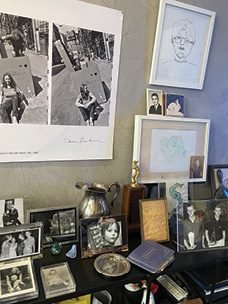
Even before I figured out that coincidence, I had nabbed the photo of June and Frank from Gwenolee Zürcher, the Swiss owner of Zürcher Gallery (33 Bleecker), which specializes in feminist and women artists. In February, I attended a panel (again, just across the street!) at Zürcher featuring Brenda Miller, Poppy Johnson, and Mary Miss. They reminisced about the fertile activist period beginning in 1969 with the Art Workers Coalition (AWC) protest movement (1969). They soon formed Women Artists in Revolution (WAR) when it was clear the men in AWC (Richard Serra, Carl Andre, Bob Smithson) didn’t believe there were any good female artists. “Their wives were artists,” Poppy Johnson said at the panel. “Assholes!” Lucy Lippard would hold the WAR meetings in her loft so that she didn’t have to get a babysitter. WAR boycotted the 1970 Whitney Biennial every weekend for four months. Faith Ringgold got her hands on Whitney Museum letterhead and put out a fake press release saying that the Biennial would have 50 percent women artists and 50 percent artists who were Black.
Wild spirits animate this issue of LIBER, too. Elana Dykewomon, one of the first subscribers to LIBER, died in 2022, but because she donated her house to a lesbian archive, her actual home is now a home to Bay Area lesbian history, a physical space for future generations to learn and take inspiration from their legacy (as Dylan Jordan writes about on page 18). Diane Torr, a downtown dancer and performance artist who led Man-for-a-Day Drag King workshops starting in the 1980s, is invoked by Tinamarie Ivey’s conversation with three generations of Kings. (Torr died in 2017.) I attended Torr’s workshop in 1996, presumably to cover it for Ms., although I didn’t end up publishing anything about it. (Note to self: dig up the photos from that night!)
I like to feel the many ghosts on this corner of Bleecker and Bowery. CBGB was kitty-corner from our front door. Even that venue’s current life as a John Varvatos store can’t fully vanquish the sublime anarchy that is still palpable on this street.
