A painter friend of mine told me recently, upon returning from a trip to the Venice Biennale preview, that she always finds herself escaping the pavilions to go see the “old stuff.” In the Biennale venues, she says she saw few paintings. There was foremost the ballyhoo of lavishly catered parties and art-world intrigue. The event kicked off with boycotts, attempts at censorship, and resignations over the participation of Russia and Israel. From reports and reviews, I gather the aesthetic vibe was provocative performance and maximalist installations designed to overload the senses (even smell). I can imagine the relief of slipping instead into a cool, dark church to see an altarpiece by Titian or Bellini—to experience the silent presence of a formally precise object made to last the ages.
In June, I experienced a similar tension within the (admittedly much quieter and less contentious) Carnegie International (Carnegie Museum of Art, May 2, 2026–January 3, 2027). The longest-running survey of international contemporary art in North America, the Carnegie International has been organized every three to five years since 1896. On a road trip from Michigan to New York City, I had stopped in Pittsburgh for one night and spent a few hours the next morning exploring the fair’s fifty-ninth edition, titled If the word we. Much of the work, for me, hung together as awkwardly as the words in the title, taken from a commissioned catalogue essay by Haytham el-Wardany. “The exhibition,” the curators write, “approaches ‘we’ not as a unified subject but as a complex and porous position, attentive to contradiction and change.” An admirable, even necessary, mission, but if the goal was to find some harmony or resonance through international dialogue, my experience of the installations began as overstimulated and cacophonous.
To be clear, my approach was not conducive to earnest inquiry. My boyfriend and I were expected in Buffalo by 6 p.m. and did not have time to appreciate or even see every work by more than fifty artists. My saturation point for conceptual pieces elucidated by neat paragraphs of International Art English is admittedly low. And as I made my way through the first-floor galleries, I found myself drawn more to artifacts of the Carnegie’s permanent collection, with which many of the Carnegie International installations intertwined. In short, I wanted to look at the old stuff.
What annoyed me most were the screens. Screens of all sizes competed with museum spaces that had, on a previous visit, filled me with wonder. In the Hall of Architecture, flanked by full-size plaster casts of the Acropolis caryatids, the Naxian Sphinx at Delphi, and part of a thirteenth-century Bordeaux cathedral, was a surround-sound video installation of a short film by New York artist Wu Tsang—putatively a visual essay on the opera Carmen, this collage of vaguely erotic and decontextualized moving images felt to me, notwithstanding the monumental size of the screen, almost indistinguishable from the experience of your average doom scroll. I was left similarly cold by the slapdash feeling of cell phones placed among the tiny furniture of the Gallery of Miniatures (in California artist Miller Robinson’s DOCTORS HAVE THE RITE TO SUCK) and affixed to handmade plastic masks by Sarah Ndele from the Democratic Republic of Congo. The latter played footage of the artist dancing awkwardly and without enthusiasm, as if watching herself in a bedroom mirror; the former were unmemorable except as a distraction from Robinson’s own delicate fish-bone sculptures and beautifully curated, miniature indigenous baskets. When Bachelard wrote “The miniature is one of the refuges of greatness,” I don’t think he had cell phone videos in mind.
I grow weary of picturing myself as someone unreceptive to modernity. It is not the person I set out to be. The disappointment I felt in the first floor of the International was less about the art itself than about my ability to receive it. I just think I see too many screens already, all the time.
I considered spending the rest of my allotted time in European Painting but derided myself for being a conservative fuddy-duddy. Then we stumbled into a second-floor gallery dedicated exclusively to the International. At the threshold was a posthumous exhibition of works by Sofu Teshigahara (1900–1979), a Japanese artist who infused his experimental paintings and sculptures with the influence of ikebana, or traditional Japanese flower arranging. The abstract sculptures were quiet and harmonious; the series of tiny iterative paintings of Mount Fuji primed me for what came next in the gallery, works by an artist I had never heard of and who became for me, instantly and inexplicably, the star of the show: Reina Sugihara.
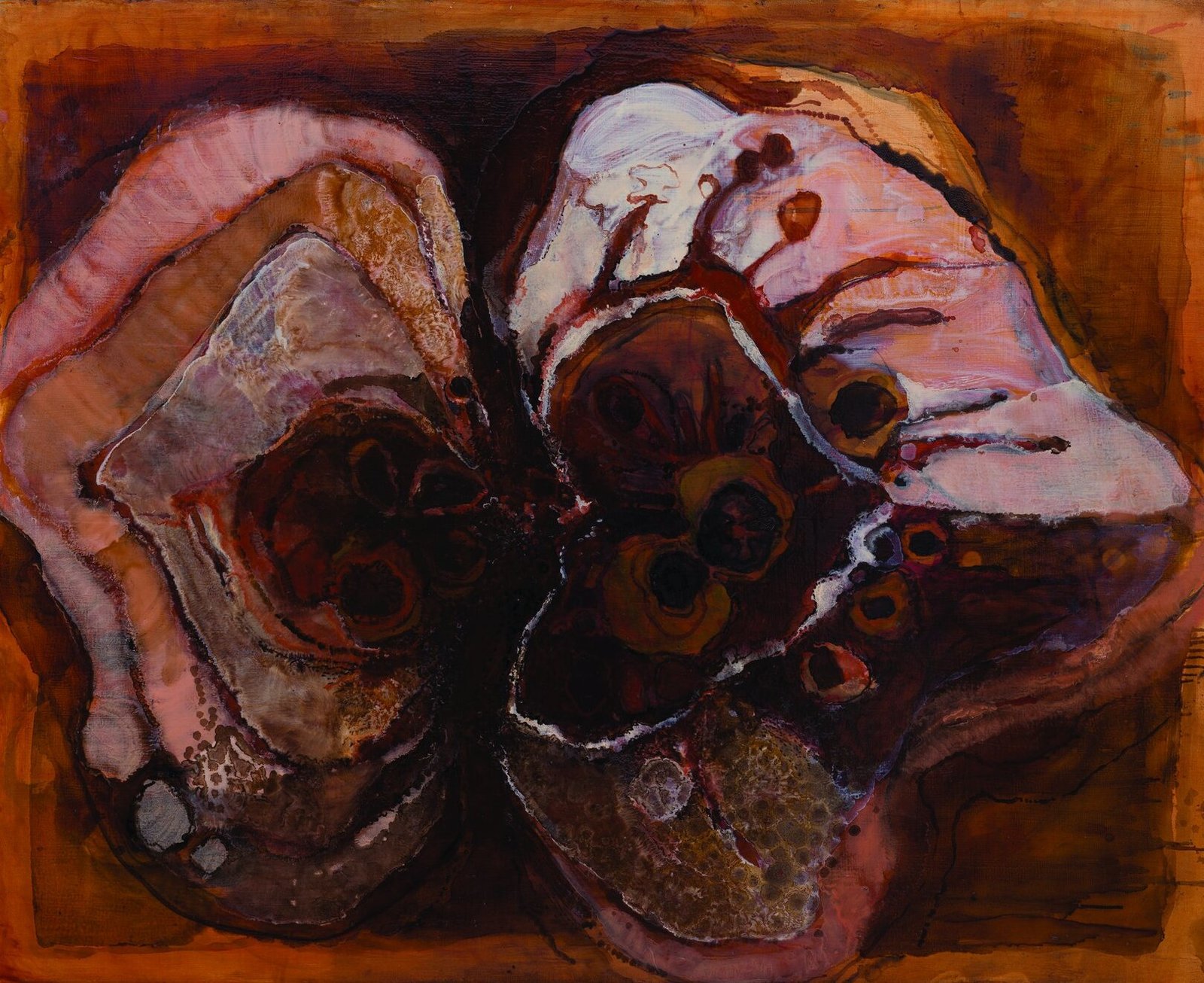
Sugihara (b. 1988), a Tokyo-based painter, labors over her canvases for long periods of time—often years, sometimes nearly a decade. According to a review of her 2024 show at Empty Gallery in Hong Kong, she works with her surfaces on the floor, circling around them in contemplation. The surfaces include canvas, board, and jute, allowing for different levels of porousness. In what the Empty Gallery press release calls a “ritualistic” process of “layering and effacement,” they accumulate strata of gesso, oil, pigment, and binders, building into surfaces both glossy and textured, forms both abstract and organic—flat, jewel-like spaces somehow suggesting murky depths of earth greens. The photos I tried to take looked nothing like the works in person. The best way I can convey my reaction: These are the opposite of screens.
. . . to look into the paintings felt like an encounter with something in the deep—alien and familiar.
Gazing into the small, obscure, almost monochromatic yet luminous pictures, I was reminded of the scene in The Life Aquatic with Steve Zissou when Bill Murray’s gang of misfits, crammed into a submarine, finally encounters the infamous jaguar shark, a Wes Andersonian analog for Moby Dick. But more so, I was reminded of the part just before that, when the submarine glides suddenly through a school of jellyfish, shocking the characters out of their petty disaffections and into a state of attention to the ineffable. The forms in Sugihara’s paintings are fleshy and ethereal, aquatic and voluptuous things resembling lungs or oysters, breasts or Medusozoa, and to look into the paintings felt like an encounter with something in the deep—alien and familiar.
That was all I wanted. Once recharged, I approached the rest of the show with a feeling of optimism and openness to being moved, including by a three-screen ceiling-mounted video installation playing obscure, collaged footage to a jazz soundtrack composed by artist Shala Miller of Cleveland, Ohio, who sometimes performs music under the name Freddie Jones. The screen’s scale and position commanded the viewer into a supine position on the ground. My boyfriend and I spooned there for a while on the cushions and felt new leaving the dark of the gallery. There is no substitute for the intimacy of a small object formed through the labor of someone’s hands. The rest is good too.