
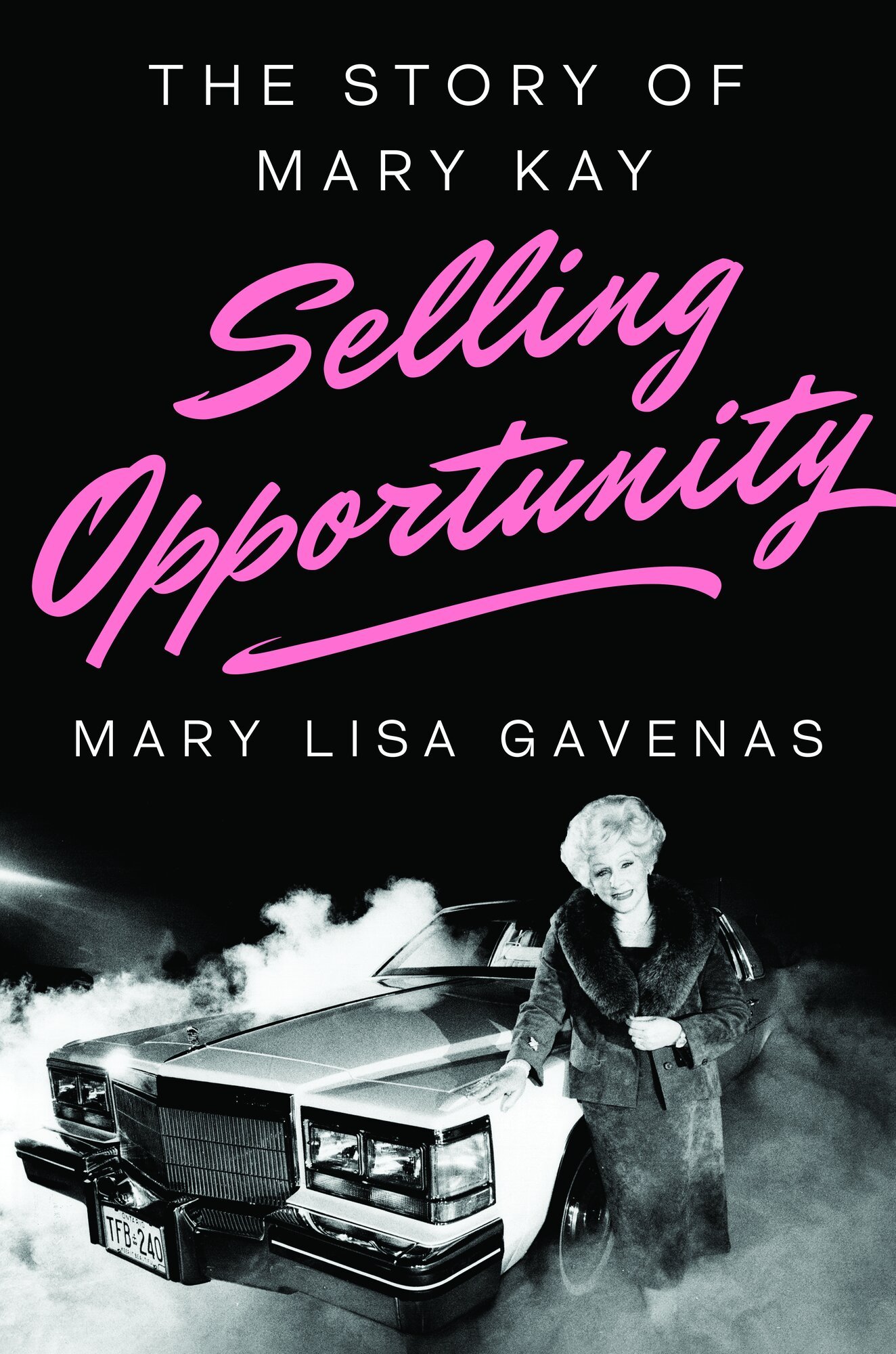
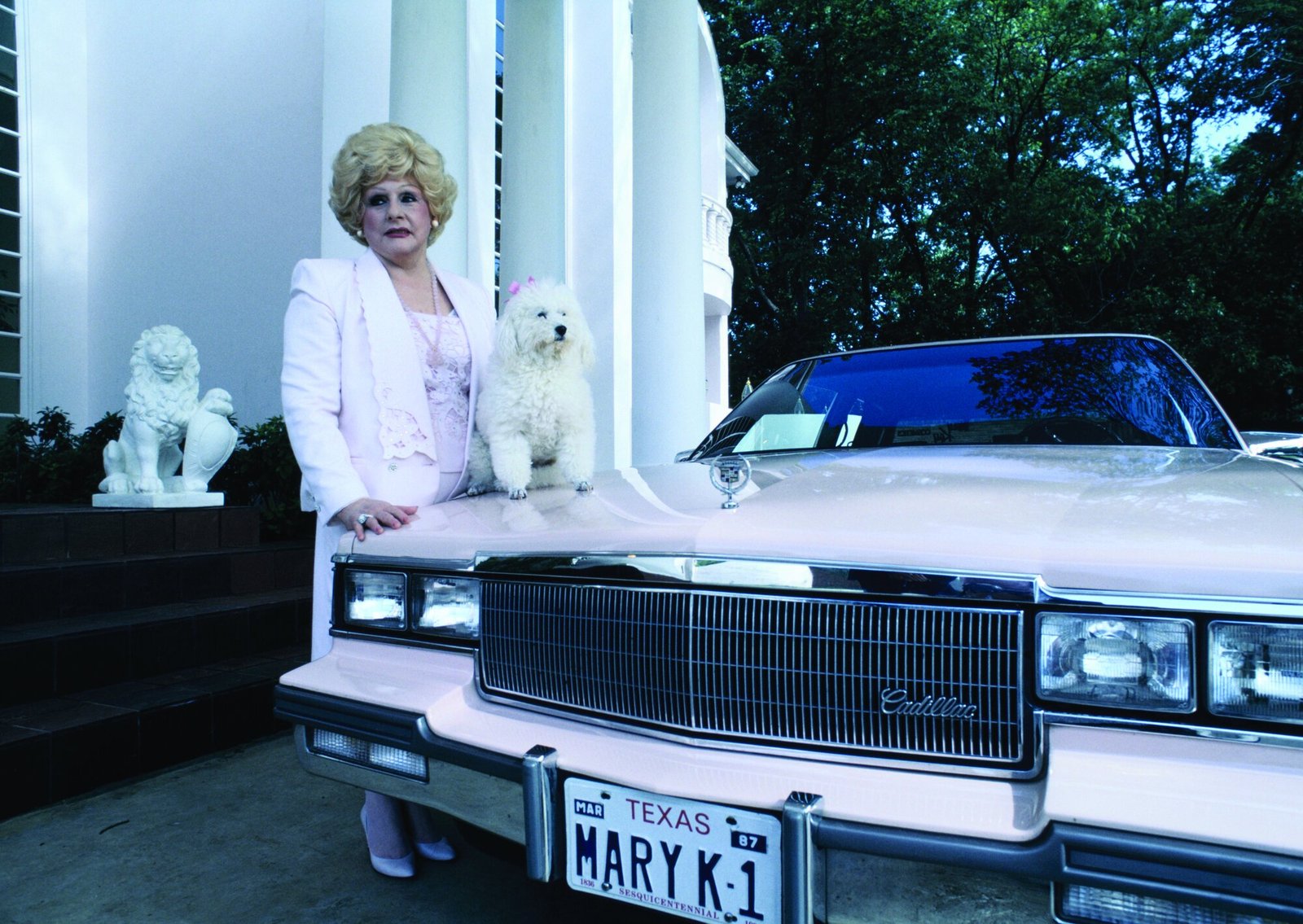
Cotton-candy platinum wig, bright pink lipstick slathered onto a slightly crooked smile, pastel eyeshadow, big shiny jewelry, and a short, grandmotherly body perched atop high heels, often seen leaning against a pink Cadillac: at first glance, it’s tempting to view Mary Kay Ash as a cartoonish emblem of regressive womanhood, Texas-style. Easy, also, to dismiss the cosmetics company she founded in 1963, Mary Kay, as a pyramid marketing scheme—if not as a tool of the patriarchy, incentivizing women to upsell flashy face potions and paints to other women, a perverse expression of the extra cost of living as a woman in sexist society. And yet . . .
Mary Kay was an off-brand feminist—someone who would have never accepted the label, or been invited to do so.
There are the facts. In her immensely entertaining and informative new book, Selling Opportunity: The Story of Mary Kay, Mary Lisa Gavenas presents a radically different interpretation. Her Mary Kay was an off-brand feminist—someone who would have never accepted the label, or been invited to do so, because of what feminism meant during her heyday in the mid to late twentieth century. In a nutshell: serious, political, and intent on proving women could do what men do. Still, Gavenas makes the case that Mary Kay was someone who realized the movement’s goals of economic equality and self-determination for women on a massive scale. Mary Kay herself rose from poverty to become a multimillionaire and the first woman to chair a company listed on the New York Stock Exchange. In the process, she offered unprecedented opportunities to other women who had the same big dreams and small circumstances. Many of her sales representatives transformed their own lives, gaining self-sufficiency for the first time. They left behind low-paying, dead-end jobs and demeaning dependence on men. A few became millionaires. (Most didn’t, of course, and Gavenas reports that before Mary Kay’s death in 2001—the point where the book ends—more than 70 percent of Mary Kay representatives had other jobs. However, none risked a big financial loss because the company guaranteed in writing that consultants could recoup 90 percent of their money by returning undamaged products less than a year old.)
A few success stories, which Gavenas recounts with exuberant wit and keen intelligence: In 1967, in Odessa, Texas, a sixty-three–year–old preacher’s widow “who looked like a real-life Ma Kettle” signed up to sell Mary Kay while recovering from a stroke. Having once worked in an overalls factory earning $4.27 every two weeks, she was soon cashing monthly Mary Kay commission checks for thousands of dollars. She went on to buy a $100,000 home, wear a $5,000 mink coat, and own $64,000 worth of antiques, “all paid for with Mary Kay money.” Starting out further up the economic scale, the wife of a Harvard Business School graduate began repping Mary Kay after her husband scolded her for buying a $1.98 ivy plant. Within a year, she’d earned today’s equivalent of more than $175,000. Other Mary Kay recruits included “women gripping the harnesses of service dogs, women using walkers or wheelchairs or crutches or canes [. . .] Muslims in hijabs, Pentecostals in ankle-length skirts, [and] former nuns who dressed like lay sisters.”
In other words, this was a kaleidoscopic portrait of American womanhood. Selling Opportunity resonated deeply with me because, figuratively, I ran into the same crowd while researching my recent social history of the Katharine Gibbs School for women (Expect Great Things!, Algonquin, 2025)—that is, women whom nobody else cared about, not really. The Gibbs School, which had its primary locations on Park Avenue in New York, in Boston’s Back Bay neighborhood, and near Brown University in Providence, Rhode Island, operated at full speed from the late 1910s through 1968 and promised to train ambitious young women for careers, not jobs, in any field of their choice. That was a highly unusual mission. At the time, many families wouldn’t pay for college for their daughters, only their sons, because the girls—fulfilling their supposed highest calling—were only going to get married, have children, and become full-time housewives. Even if the girls did make it to college, even if they made it to the Seven Sisters, the primary goal of their education was to polish them up culturally so they’d be useful accessories to their husbands. Married or not, it was the rare ambitious female scholar who pushed through to law, medical, or business school before 1970, an era when the nation’s professional schools accepted women either in minuscule numbers or not at all.
Before the women’s liberation movement took on these sex-segregated career opportunities, Katharine Gibbs offered a workaround in the form of a Trojan Horse campaign: enter the workforce as an executive secretary with perfect skills, social finesse, and cultural polish—the latter imparted by Ivy League and Ivy-equivalent professors moonlighting at Gibbs. Then learn everything at the top level, make important contacts, and ultimately elbow the boss aside or start your own company.
So, while reading Selling Opportunity, I was struck by the similarities between Katharine Gibbs and Mary Kay Ash. Both women started their businesses fueled by anger and dire straits. Katharine Gibbs, born in Illinois in 1863, had been betrayed three times by the men who were supposed to protect and provide for her. Her wealthy father died without a will; her brothers took everything; and her husband died in a freak accident, also without a will, leaving her in 1909 to the non-mercy of the state. Although she’d been an exemplary mother, she had to petition the courts for custody of her two young sons.
Mary Kay, after more than two decades of highly successful “party plan” sales, peddling mops and brooms and toilet brushes for Stanley Home Products and knickknacks like wood-fiber roses for World Gift, was likewise shoved in a corner. The best Stanley offered her was a branch manager’s job, with the net effect of reducing her income. No thanks. World Gift was worse. As national training director, after expanding the company into forty-three more states, she had to train an inexperienced young man who was then promoted over her. “I found that no matter how well I did my job, no matter how smart I was, I still always seemed to reach a golden door marked ‘Men Only,’ ” so she, too, designed a workaround, a new path to financial independence for women, made with women in mind.
For instance, contrary to popular practice, Mary Kay’s direct sales company didn’t sell to territories because Ash saw how women’s jobs were tethered and subordinate to those of their husbands. If a husband got transferred to another city, there went the wife’s income. Thus, all Mary Kay representatives could sell anywhere and everywhere, and they got promoted strictly according to revenue (products sold) and the number of women they recruited to sell. Mary Kay encouraged the representatives relentlessly, gushingly. “Even if she falls flat on her face [. . .] we tell her how beautifully she fell and make suggestions as to how she could do even better. We never criticize. Always praise, praise, praise,” she said. At every step of accomplishment, she handed out what she called “Cinderella gifts”—gold-plated goblets, diamond bumblebee pins, mink stoles, pink Cadillacs—“the things that we wait around for that guy on the white horse who never shows up to bring us.” Her words and gifts fed a starving population. “Such praise had never fallen on me [. . .] it filled a void inside of me I hadn’t even known as there,” says one grateful woman quoted in Gavenas’s book.
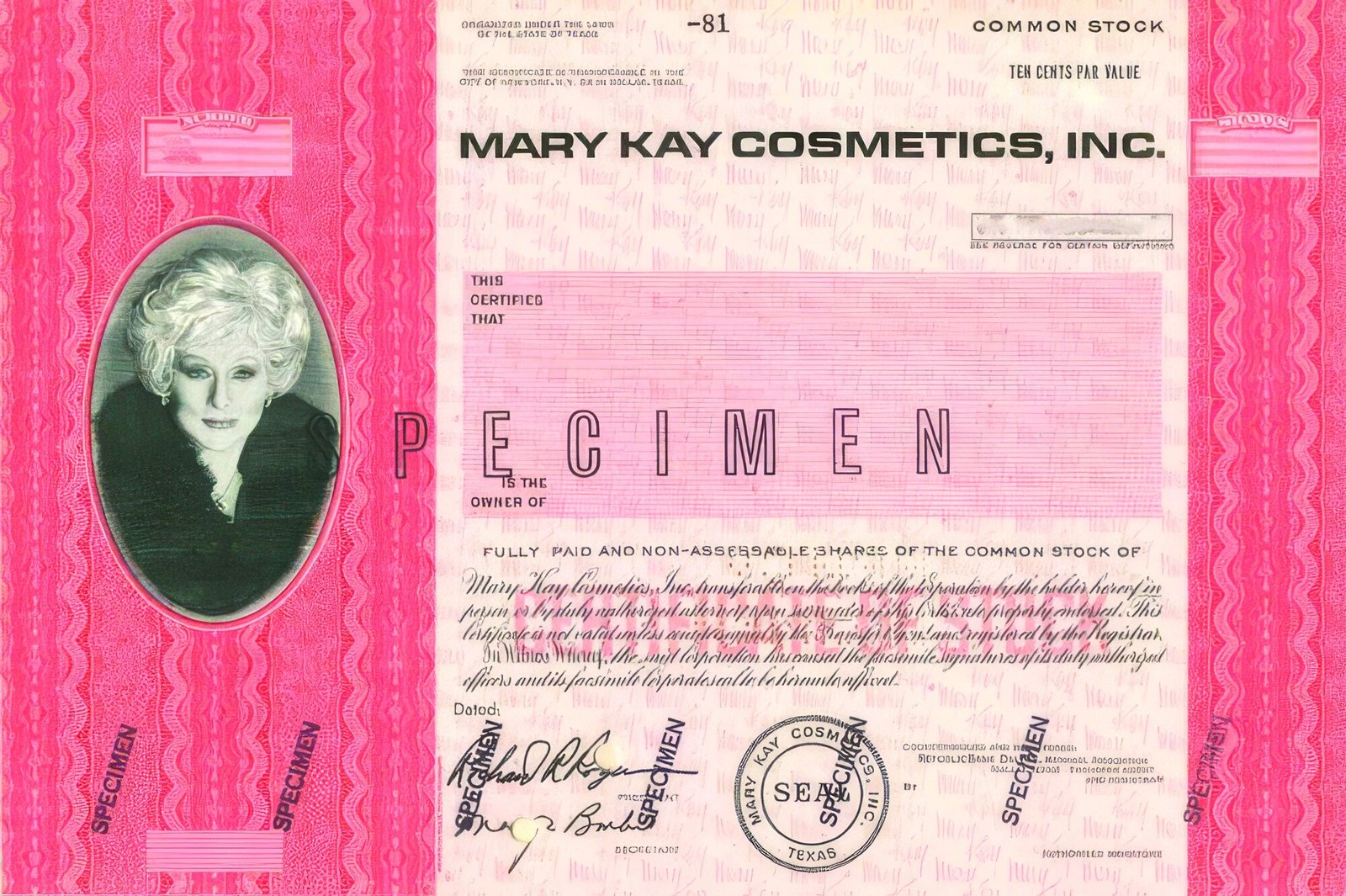
Considering all they accomplished, it’s curious that historians are just now taking a look at Katharine Gibbs and Mary Kay Ash. The Gibbs School had more than 50,000 graduates by the late 1960s. Among them were a best-selling young adult novelist; the head of the Women Marines; an author of Wonder Woman comics; a college president; a US ambassador; and Emmy Award-winning actress Loretta Swit. Listed on the New York Stock Exchange in 1976 and named sixteen years later to the Fortune 500 list, Mary Kay to this day remains a multibillion-dollar enterprise with 3.5 million representatives in thirty-five countries—everywhere from China to Russia to Malaysia to Mexico.
But maybe it’s not so curious after all. Each woman represented the wrong kind of history. During Katharine Gibbs’s era, history was his story, but Mary Kay had a different kind of bad timing. The same year the company began, 1963, Betty Friedan threw her literary hand grenade The Feminine Mystique into American society. The explosion of second-wave feminism that followed spawned a women’s liberation movement full of writers, radicals, activists, theorists, and intellectuals—not women who wanted to stay close to the center. Far from critiquing makeup and beauty standards as a part of women’s oppressed state, Mary Kay reps followed a dress code that required skirts (no pants!), hosiery, heels, and conservative hairstyles. Nevertheless, they wanted economic freedom and worked hard to get it.
For more than thirty years, third-wave feminists have modeled a more expansive understanding of who might rightly be called feminist. Selling Opportunity arrives to suggest that these pragmatic foot soldiers deserve a place at the table too.