
The Netflix series Bridgerton features a plotline about a nineteenth-century noblewoman desperately seeking a sexual “pinnacle” that coitus withholds from her yet not her husband. Meanwhile, the New York Times Wirecutter product review site recommends vibrators you can buy at Walgreens.
My, times have changed.
Fifty years ago, when feminist writer Shere Hite (1942–2020) published The Hite Report: A Nationwide Study of Female Sexuality, one of the best-selling books of all time, conventional wisdom dictated that plain old intercourse was the ticket to orgasm for women as well as men. Any woman who needed clitoral stimulation was deviant or trapped in her “phallic” stage; a mature woman achieved orgasm through the vagina (thanks, Freud). Hetero men didn’t know that what felt good for them didn’t necessarily feel good for women. Many women chose to fake pleasure rather than speak up because they were embarrassed or, rightly, worried about being belittled as pushy and slutty.
The women’s liberation movement cracked open this shell of ignorance and silence. Thus inspired, in 1972, Hite began distributing her revolutionary fifty-eight–question anonymous survey about women’s sexual experiences through the auspices of the National Organization for Women and other women’s groups, with notices in magazines from Brides to Ms. sharing information on how to obtain the questionnaire.
Hite got right to it. Her first question was: “Do you have orgasms? If not, what do you think would contribute to your having them?” Question 14: “How do you masturbate? Please give a detailed description. For example, what do you use for stimulation—your fingers or hand or the bed, etc.? Exactly where do you touch yourself? Are your legs together or apart? What sequences of events do you do?”
Of the hundred thousand surveys distributed, approximately three thousand women, aged fourteen to seventy-eight, from around the US responded, and their answers formed the basis of The Hite Report. The most explosive finding was that 70 percent of these women did not reach orgasm through penetrative sex alone, and since most were not receiving clitoral stimulation, most were not orgasming. Millions of women realized there was nothing wrong with them or their bodies. “I’m convinced I’m not abnormal,” wrote one woman to Hite. “It’s the greatest relief of my life.”
The book was an instant sensation. “Read The Hite Report if you want to know how sex really is right now,” Erica Jong wrote in The New York Times Book Review. Time said, “Many female readers can closely identify with these intimate revelations.” To the National Observer, the book was “a bombshell.” It didn’t hurt that Hite was captivatingly gorgeous and flamboyant; she didn’t remotely fit the false, absurd, and cruel stereotype of the ugly feminist who hates men because she can’t get one. The Hite Report went on to sell 50 million copies (the same as Lolita).
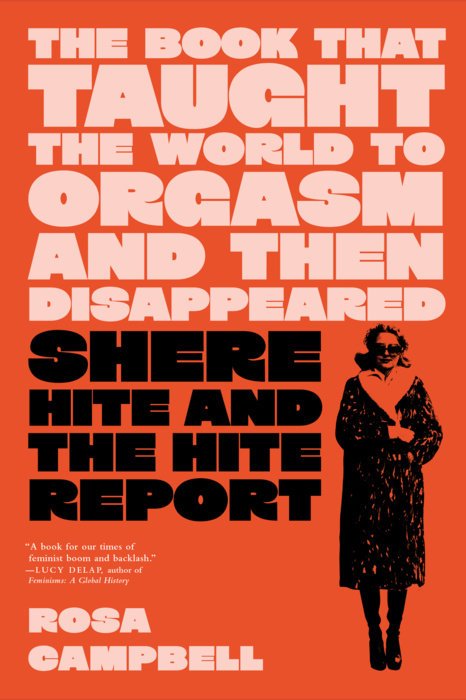
Rosa Campbell revisits this thrilling publishing story in The Book That Taught the World to Orgasm and Then Disappeared. Her objective is three-fold: recover the lost history of how Shere Hite set the record straight on female orgasm, use Hite’s story as a case study in how feminist knowledge gets systematically suppressed, and apply knowledge about the denigration of Hite’s work to our current political moment.
“It’s hard to imagine how a book like this could be wiped from public memory,” Campbell writes. Agreed. Many young people, including those who care about feminism, have never heard of Shere Hite (or Our Bodies, Ourselves or Betty Dodson). But it’s worth noting, as Campbell does not, that The Hite Report remains in print in the US from Seven Stories Press, which is an enormous accomplishment for a fifty-year-old title. Seven Stories also published a collection of excerpts of all of Hite’s most important works (The Shere Hite Reader) and will reissue The Hite Report on Male Sexuality in spring 2026—evidence that there is continued interest in this second-wave visionary.
Campbell is clear about how radical Hite’s book was and how, in the years following The Hite Report, Shere continued to reveal knowledge based on her research that many people simply do not want to know. The Hite Report on Male Sexuality suggested, for instance, that cultural stereotypes about masculinity deeply inhibited men’s emotional and sexual lives. In Women and Love, she reported that nearly all her women respondents were emotionally unfulfilled in their hetero relationships. In The Hite Report on the Family, she argued that men raised by single mothers often enjoy better relationships with women than those raised in nuclear families.
[Hite] reported that nearly all her women respondents were emotionally unfulfilled in their hetero relationships.
Her findings undermine our most basic assumptions about marriage, gender, and the roles assigned therein, as well as the importance of a father in a boy’s life. Campbell argues that Hite became persona non grata because of right-wing denigration of her work, and this is true—but it is only part of the story. What happened to Hite was not orchestrated, but it was nearly as effective as if it had been: methodological critique, sexual shaming, and media personalities’ desire for drama, even or especially at the expense of their featured guest, converged and reinforced one another until they were indistinguishable.
Critics pounced on her research methodology first. Mainstream news reporters from the Chicago Tribune, The Washington Post, Newsweek, London Review of Books, and many others were quick to proclaim that Hite’s findings were worthless. Her survey results were not from random or representative US women; they were self-selecting—women who had a lot to say about Hite’s questions. Critics belittled the findings as inherently biased toward sexual dissatisfaction, reasoning that women who had a happy sex life were less likely to spend so much time recording their responses. Yet previous sex researchers, from Freud to Kinsey to Masters and Johnson, similarly failed to mirror the populations they described. Besides, it’s simply not possible to conduct sex research on a random group of people because most people would opt out. The methodology critique was a convenient intellectual cover for an attack that was really about something else: denying women’s sexual grievances to mask men’s sexual-performance weaknesses. Campbell writes:
On talk shows, interviewers wondered aloud if “what emerges from the book . . . is 3,000 desperately to moderately unhappy women, women who are not getting what they want . . . Aren’t they the ones who are likely to reply to this questionnaire?” What this amounted to was saying in fact that actually, normal women do orgasm vaginally after all, and so nothing need change between men and women sexually. Shere reminded the media that the book had been read widely and that the thousands of letters she received from women corroborated her findings. If there were lots of women who were having vaginal orgasms, surely she would have heard from them.
Critics who already had decided that a former model had no business conducting sex research were never going to be persuaded by a stronger sample size. Her qualitative methodology was sound, and she went to great lengths to quantify her findings. One of her research assistants, Dylan Landis, told Campbell about keeping track of survey responses on “giant sheets of graph paper.” A page with “Do you like to masturbate with your knees up or down, legs open or closed?” written at the top included columns with labels such as clit. stim.
If Hite had acknowledged that her research methods were unconventional while pointing out their undeniable and unique strength in creating a forum for people to open up about their most private thoughts and actions, perhaps she could have shaved off some of the critiques. Instead, she doubled down on the reasons there was nothing wrong with her work, probably because she worried that if she conceded any weakness, she wouldn’t be taken seriously as an intellect. Nevertheless, she was not taken seriously as an intellect.
It’s one thing to trivialize a researcher’s methodology. Many critics went further, discrediting Hite personally. Earlier, as a graduate student at Columbia in the 1960s, she had earned her living as a nude model, posing for Playboy, a James Bond movie poster, and photographers who sold their work to Times Square sex shops. Hustler reprinted photos from this chapter in her life, which unleashed a torrent of vicious criticism. How could this slut be taken seriously? That she was feminist, too, made her a target from every angle. A woman who had displayed her body for money had forfeited the right to be heard about what women’s bodies actually experience. “To her conclusion that women are scared to ask men what they want because of inequality,” Campbell writes, Hustler made “a sexual threat dressed up as a joke, as they so often are: ‘Come on Shere, all you need to do is ask, and the entire male staff of Hustler will gratify you—simultaneously.’”
The ugly political and personal attacks intensified, particularly after she published The Hite Report on Male Sexuality and Women and Love in the 1980s (with the backlash in full swing). With the legalization of no-fault divorce in a substantial majority of states, women’s increased financial independence, and mothers’ participation in the labor force, marriage was no longer the default goal of virtually all women. Conservative pundits and religious leaders worried that if women didn’t need men for sexual satisfaction, the heterosexual family unit was in peril.
Then there was television, which should have been charismatic Hite’s friend. But the 1980s brought shock-shlock talk shows. Maury Povich mocked her to her face. Even Oprah—Oprah!—set her up with a hostile all-male audience, a betrayal and humiliation that must have stung in ways that a bad book review never could. Her residential address was publicized and she received death threats.
At this point, Shere Hite’s life was off the rails. Campbell reveals, and I was shocked to learn, that Hite hired lawyer Roy Cohn—the same Roy Cohn who played a central role in prosecuting the Rosenbergs and encouraging their executions, and mentored young Donald Trump—to sue a New York magazine journalist who had written that Hite’s experiences as a porn model had shaped her opinions. In her own memoir, Hite wrote about the lawsuit and settlement but didn’t name her attorney. That Hite turned to one of the most loathsome figures in American public life suggests to me she believed she had few options in defending her reputation, but Hite could be a diva and couldn’t help making things worse for herself.
“I cannot exaggerate, it really had to be all about her,” Hite’s girlfriend Joanna Briscoe told Campbell. As a houseguest, Briscoe recalls that Hite was “liable to fly off the handle at a perceived slight or injustice, yell and scream, then withdraw for days under the guise that ‘she was resting her voice,’ communicating only via handwritten note.” Hite said that she had “replaced Freud.” She walked off live TV sets. She rang up reporters using a fake name to impersonate a nonexistent secretary and then concocted an elaborate ruse to “prove” the fake secretary’s existence. She physically assaulted a limousine driver after he broke the news that she was running so late there was no way they could get to her next media appearance in time.
Meanwhile, a dispute with the New York chapter of the National Organization for Women led to a lawsuit. (NOW was where Hite had had her activist awakening; in 1972, after having modeled for an Olivetti typewriter ad, she joined a NOW protest of this very campaign when, as she often said, she discovered the sexist tagline—“The typewriter so smart, she doesn’t have to be”—under her photo.) NOW claimed that Hite had agreed to pay them for allowing her to use their logo and address on her questionnaires, yet all they had to show for their agreement was fifty dollars. The lawsuit was settled out of court. She began to spend more time in France and eventually moved to Germany with her German husband. At that time, dual citizenship was not permitted, so Hite chose to renounce her US citizenship and become a German citizen.
Once you know how critics treated Hite and how she responded, it’s not surprising that she faded from public awareness. Besides, her biggest accomplishment—increasing knowledge about the centrality of the clitoris in women’s orgasm—is no longer daring; it’s absorbed into mainstream knowledge. Her punishment for being right is that nobody remembers she had to argue the point.
Which brings us back to one of Campbell’s central claims—that Hite single-handedly changed everything. In Campbell’s narrative, women who experience sexual pleasure owe it all to Shere Hite: “Without The Hite Report, there would be no understanding, now common sense, that great sex means pleasure for all involved,” she writes. “Without her book, there would be no imperative that women speak up about what they want in sex, no knowledge of the clitoris as important for women’s pleasure, no sparkling anatomical vagina Christmas decorations to hang on the tree in place of the angel, the bell-as-clitoris jingling away.”
The holiday-decor analogy is a strange detour, but the bigger problem is that Campbell’s assertion is neither wholly accurate nor fair. Quite ironically, Campbell erases—“disappears”—the pioneering work of Hite’s feminist predecessors and contemporaries. Before The Hite Report, a number of people involved in women’s lib demonstrated the importance of clitoral stimulation. In “The Myth of the Vaginal Orgasm,” written in 1968, radical feminist Anne Koedt stated, “It is the clitoris which is the center of sexual sensitivity and which is the female equivalent of the penis.” Campbell notes Koedt’s contribution but downgrades its significance (“Shere wondered if it were true”). In the first iteration of Our Bodies, Ourselves, published in 1970, the Boston Women’s Health Book Collective authors stated, “Many of us can’t have satisfactory orgasm through penetration alone. . . . Many of us want direct manual or direct oral stimulation of the clitoris.” In the 1972 book Free and Female, Barbara Seaman revealed that in her survey of a hundred women, half stated they couldn’t achieve orgasm without clitoral stimulation. Sex educator Betty Dodson was leading workshops since the late 1960s in which she taught women how to use the Hitachi Magic Wand, designed to alleviate backaches, for off-label usage. And Nancy Friday’s 1973 My Secret Garden and Erica Jong’s 1973 Fear of Flying had already blown open the conversation about women’s sexual desire. Campbell mentions these books only in passing.
Don’t get me wrong—Hite’s work was staggeringly important and influential. Men as well as women snapped up her books, and the number of copies sold is incredible. She was brave and tenacious and insatiably curious. She absolutely deserves credit for helping to change the dominant conversation about female sexual pleasure and for encouraging women to speak up about their most intimate behaviors. But a feminist historian should have firmly situated Hite’s work as part of a larger movement and cultural wave, where it belongs. By omitting or downgrading the contributions of Hite’s predecessors, Campbell burnishes Hite’s importance, which has the ancillary consequence of achieving the same result for Campbell herself. Indeed, throughout The Book That Taught the World to Orgasm and Then Disappeared, Campbell glamorizes herself, along with her subject.
I met Hite in 1995 through our mutual friend, Barbara Seaman, and we three dined and dished over sushi on Manhattan’s Upper West Side, when she was promoting The Hite Report on the Family in the US. I found that her physical beauty and chic projected a halo. Campbell never met her biographical subject, whom she portrays as a feminist Aphrodite, yet she writes about “the amount of time I have spent with her.” She says “like a siren, Shere beckoned me into her own sea. She suggested I do a project about her. I might go to her archive, swim in her words, and put them together with mine. So I did, and she came alive to me.” Campbell describes her giddiness over opening folders filled with Hite’s Post-it notes, handwritten and typed scripts, article drafts, to-do lists, notes written on napkins during restaurant meals, fabric samples for clothing she had made to measure, even a clip of her hair:
I first visited [the Hite papers] the day after Donald Trump was elected for the second time. . . . Despite the tragedy of a second Trump presidency, I skipped up the steps, excited to meet Shere through the more than 280 boxes in her archive. . . . The archivists brought Shere to me on a trolley, one box and then the next and the next. . . . She was all around me, tiny particles of her in the air, her skin, her dust, her paper, my hands. Shere, Shere, everywhere.
There is something uncomfortable about this level of infatuation in a serious work of historical recovery. It goes beyond admiration for a subject into a kind of merger fantasy that makes it hard to trust Campbell’s critical judgment—and that may help explain why she can’t bring herself to situate Hite within a broader feminist movement rather than above it.
Campbell even misleadingly suggests she is the first person to care enough to request access to the letters Hite received from readers. “To chart this history,” she writes, “I use the thousands of letters Shere received from women and men in the United States and around the world. No one except Shere Hite has read these letters before.”
It’s technically true that Campbell was the first researcher to access these letters at the Schlesinger Library (it goes without saying that the archivists have read the letters, and we don’t know with whom Hite shared the letters). But the reality is more complex than she lets on. In fact-checking Campbell’s book, I learned that the public-response letters in the Hite collection were originally closed to researchers because the names of the letter writers had not been redacted. Campbell’s interest in the letters prompted a thorough review of the material by Schlesinger staff, who determined that the letters can be opened for use by researchers who agree to specific conditions of use that protect third-party privacy.
Aside from sharply criticizing Hite for confusing white women’s experiences with all women’s experiences, regardless of race, ethnicity, and global region, I don’t see in Campbell’s pages much that is new, with the exception of the Roy Cohn bombshell and excerpts from some of the letters Hite received. In fact, Campbell appears to have relied heavily on the reporting conducted by Nicole Newnham for her 2023 documentary, The Disappearance of Shere Hite, without crediting the film. Newnham’s sources, including the Schlesinger collection, Hite’s memoir, and people who knew Hite, all appear in Campbell’s book (although Newnham conducted significantly more interviews1).
Campbell notes that we are again experiencing an assault on women’s autonomy, which is the reason it’s crucial to recover works like Hite’s. Today, alt-right magazine Evie tells brides anxious about having sex the first time on their wedding night that it’s possible they’ll achieve orgasm—not because of clitoral stimulation, which goes unmentioned, but because of the release of the hormone oxytocin. The Heritage Foundation openly plans to shape a new America in which fewer women attend college, more women marry men and have babies when they’re young, and access to abortion and birth control is severely limited. God knows we need a big dose of Hite’s courage and creativity—but perhaps we can also learn from her mistakes and not repeat them.
- Other aspects of Campbell’s book that give me pause include, among others, incomplete endnotes in the print edition (the publisher told me that full endnotes would appear in the e-book, but I wonder if that is the case only because I asked); factual errors (stating at one point the wrong number of questions in The Hite Report survey); replicating Hite’s binary view of gender (nonbinary people are absent from this book); and describing Hite as having been born “an illegitimate child” (this hurtful pejorative should be eradicated). ↩︎